Order. Insight. Accountability.
Operational data you can trust
From time registration and project requests to resource assignment, billing and reporting.
Ordinum structures the data behind requests, resource allocation, time registration, financial reporting and cross-functional operations in a relational model. It preserves historical validity and applies validation and workflow controls so operational data can be trusted throughout the organisation.
From operational capture to reliable reporting
Each example starts with a familiar controlling problem and shows how Ordinum can turn fragmented data and manual checks into a more controlled process.
Validated time registration & financial accuracy
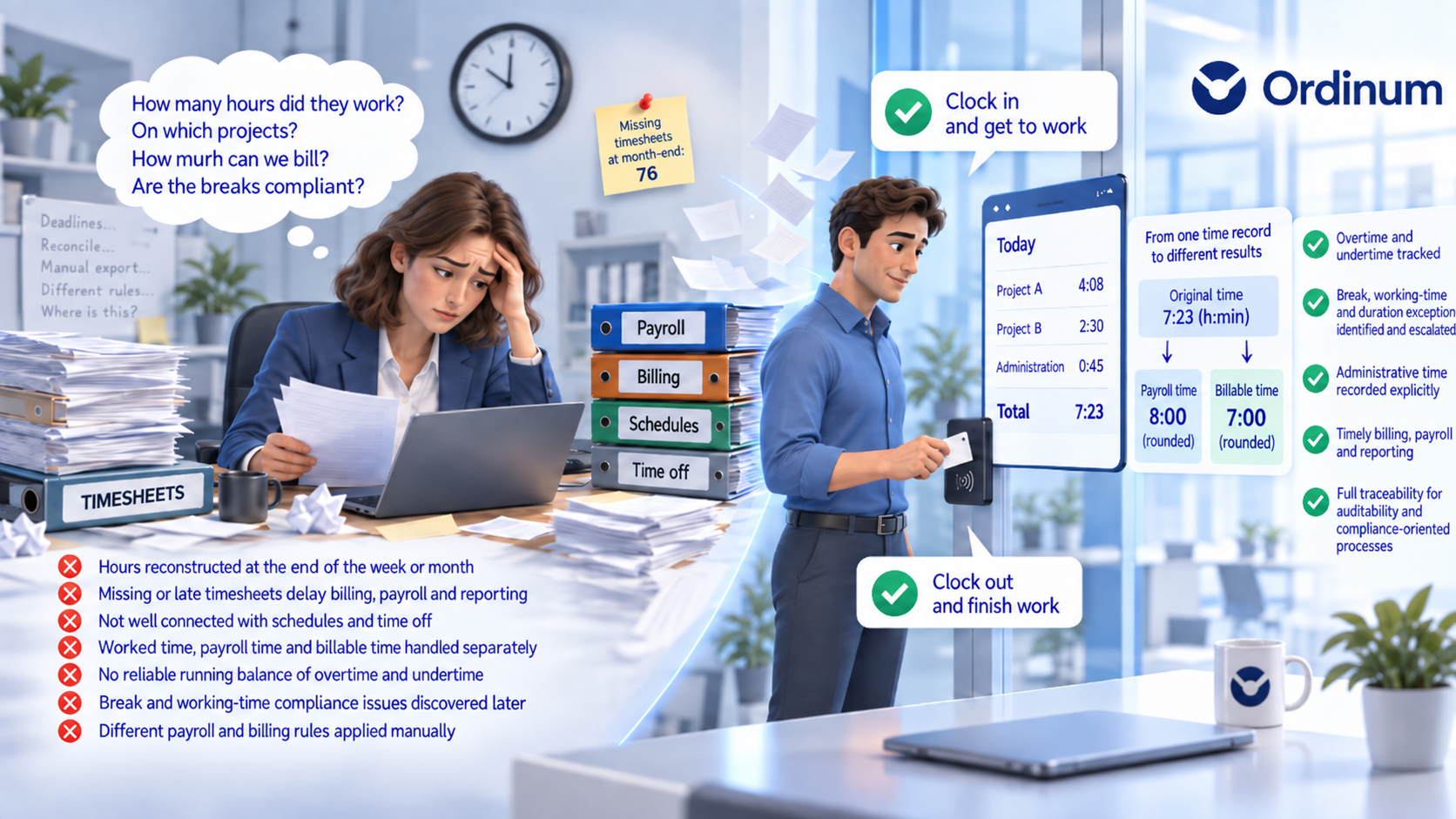
Ordinum links validated projects and assignments to app- or NFC-based time registration, preserves the original time record, and applies separate payroll and billing rules for accurate, auditable processing.
Do you recognise this situation?
Accurate working-time records are required, but day-to-day practice is less controlled. Employees reconstruct their hours at the end of the week, or even the month, while missing or late timesheets delay billing, payroll and reporting.
At the same time, the time-registration system may not connect neatly with schedules and time off, distinguish worked time from payroll and billable time, or keep a reliable running balance of overtime and undertime. Issues related to break requirements, maximum working-time limits or unusual working patterns may only be discovered later, while different payroll and billing rules still have to be applied manually.
Ordinum brings these steps into one controlled daily process. Employees clock in and out and allocate their time against valid assignments, while schedules, time off and expected working hours provide the context. Payroll and billing rounding rules are applied automatically and separately without altering the original time record, and overtime and undertime are maintained as running balances.
Break, working-time and work-duration exceptions can easily be identified, reviewed and escalated, while administrative time is also recorded explicitly. Because time is captured, allocated and processed continuously rather than reconstructed weeks later, billing, payroll and reporting become more timely and reliable, while the original records, calculations and subsequent changes remain traceable for auditability and compliance-oriented processes.
Controlled project requests

Ordinum connects project requests, contracts, changes and approvals in one validated workflow.
Do you recognise this situation?
A project time-registration request arrives in controlling by email, together with a contract. A few days later, more requests for the same project appear: one is a duplicate meant to speed up the registration, another is a change request for an assignment that does not yet exist, and another refers to an outdated or incomplete contract draft. Some information arrives by email, some by Teams, and because the request comes from a country head, partner or project manager, it is expected to be processed quickly.
Controlling then has to determine which request, contract version and system information is correct. This often means searching through emails, comparing attachments, following up with PMO or project managers, and creating local folders just to keep track of what should have been clear from the start.
Ordinum helps by connecting project requests, contracts, change requests and approvals in one structured workflow. Contracts can be attached to requests, changes can be tracked, contract information can be reviewed quickly, and approvals can follow a clear chain before data is entered into the system.
Resource allocation & billable capacity
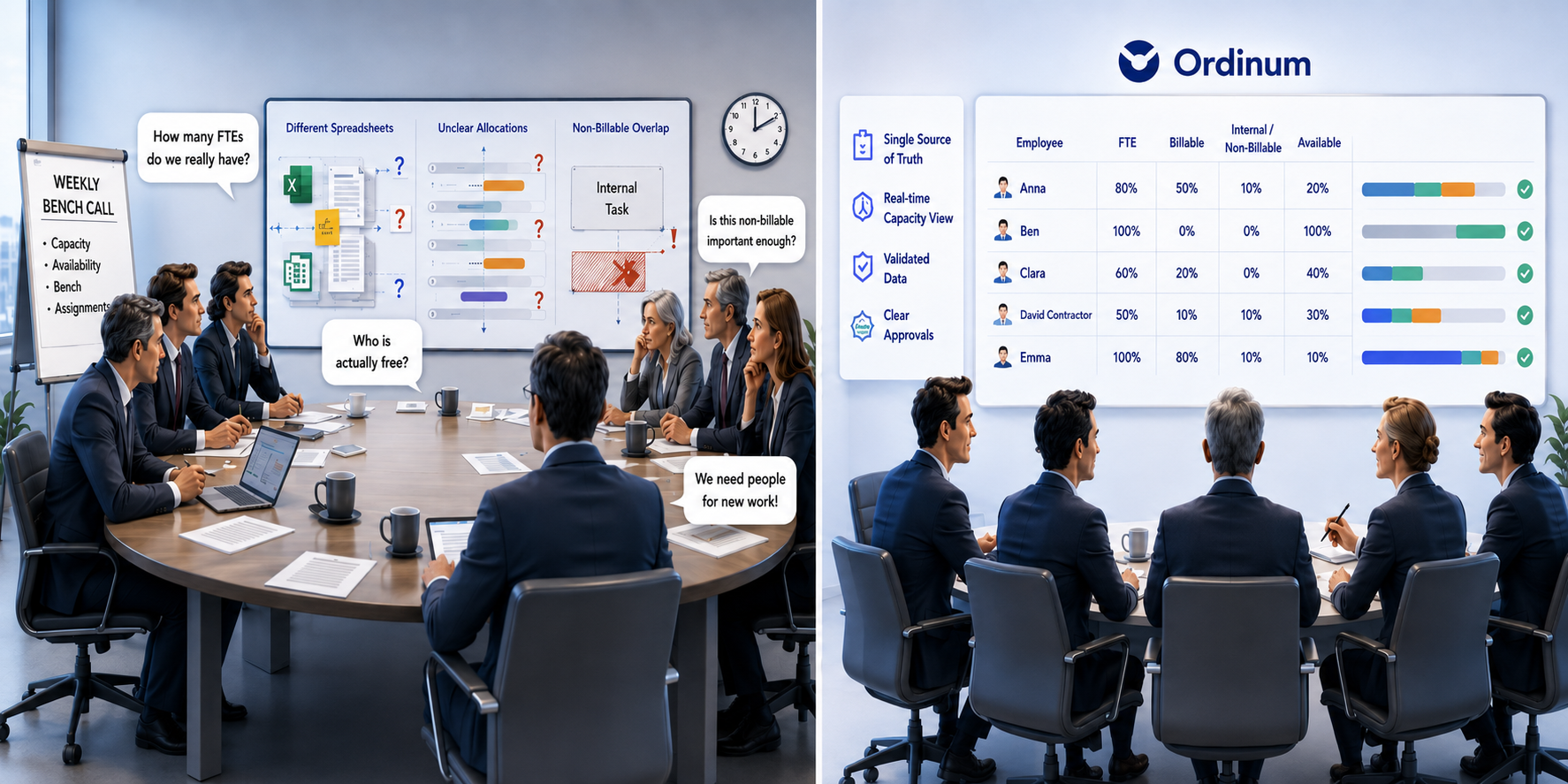
Ordinum connects HR, project, schedule and contract data to provide a reliable view of FTEs, assignments and billable capacity.
Do you recognise this situation?
The employment percentage and work schedule of an employee may not have been clearly defined. Contractor availability may be uncertain. Resources can be spread across several projects, with allocations changing over overlapping date ranges. At the same time, non-billable tasks can quietly consume the capacity of people who would otherwise be available for billable work.
Over time, the organisation loses a reliable view of how many FTEs it actually has, where that capacity is committed, and which resources are genuinely available for new assignments. The result is avoidable bench time, lost billable capacity and repeated management discussions simply to establish the current situation.
Ordinum helps by connecting employment data, work schedules, project assignments and billable availability in one structured view. Date-range checks, built-in approvals and other data-quality controls help prevent overlaps and inconsistencies, making FTE reporting, capacity planning and resource assignment much more reliable.
Cross-functional data alignment
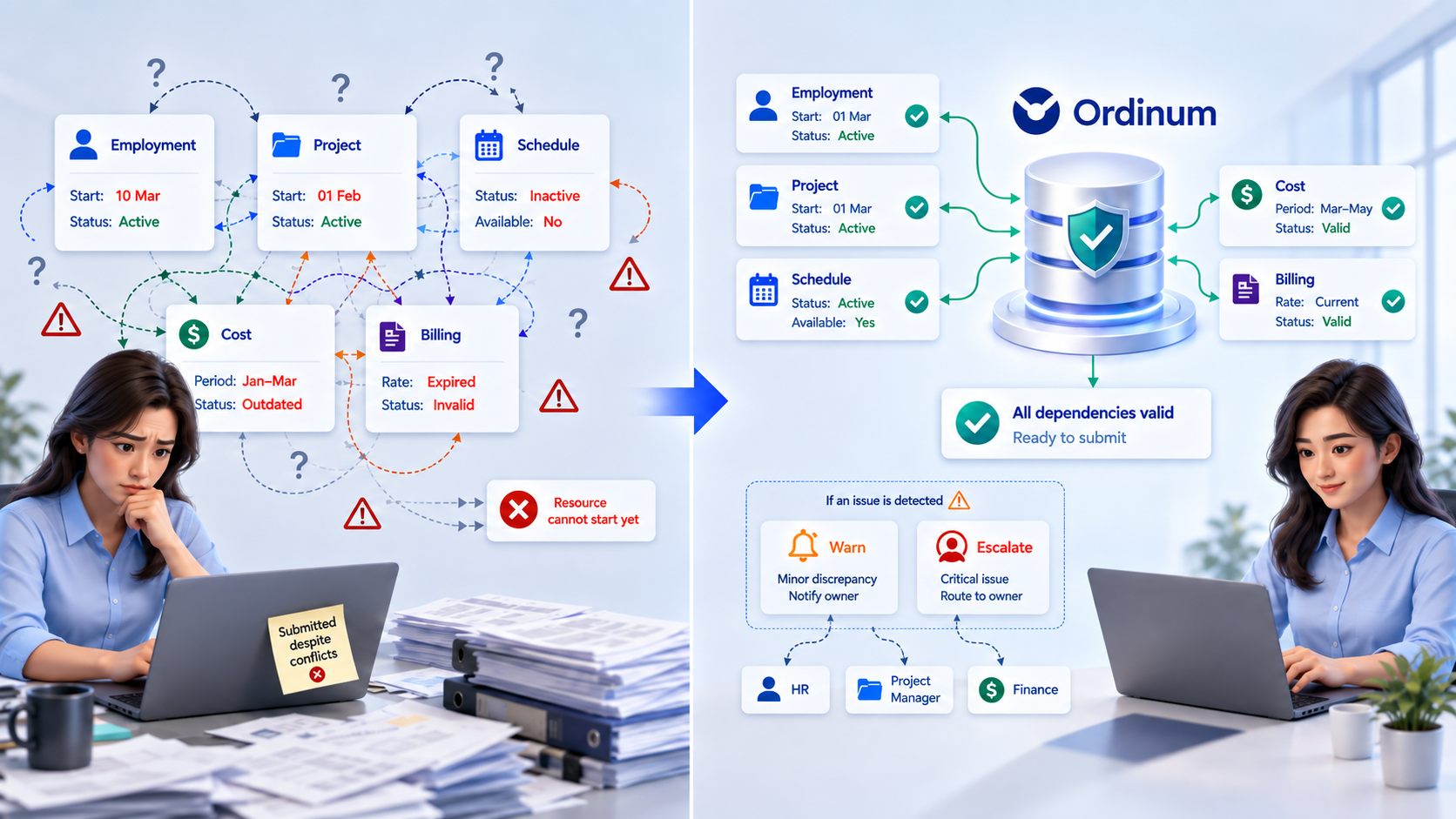
Ordinum cross-checks employment, assignment, schedule, cost and billing periods, flagging or routing inconsistencies before they become downstream errors.
Do you recognise this situation?
Employment data, project assignments, schedules, costs and billing rules do not always align as they should.
A resource may be assigned to a project before their employment or contractor relationship is active. A freelancer may still appear in project planning even though their schedule shows no availability in that period. Updated employment conditions may not be reflected in the applicable cost periods. And project assignments or specific tasks may continue to be linked to billing rates that are no longer valid.
Because the relevant information sits across disconnected departmental systems, such inconsistencies can persist unnoticed. HR, project management, scheduling, controlling and billing may each hold part of the truth, while no one sees clearly whether the combined result is actually coherent.
The consequences are more than administrative. Misaligned master and transactional data can lead to planning errors, incorrect cost recognition, wrong billing rates, avoidable follow-up work and reduced confidence in the underlying data.
Ordinum helps by checking these dependencies before data is submitted or processed further. Date ranges, employment status, project assignments, schedules, cost validity and billing validity can be cross-checked automatically. Where a conflict is critical, submission can be blocked until the issue is resolved. Where appropriate, the system can instead issue a warning or automatically escalate the discrepancy to the responsible department for review.
The result is better aligned operational data, fewer downstream errors and greater confidence that HR, project, schedule, cost and billing information remain consistent with one another.
Reliable consolidated reporting
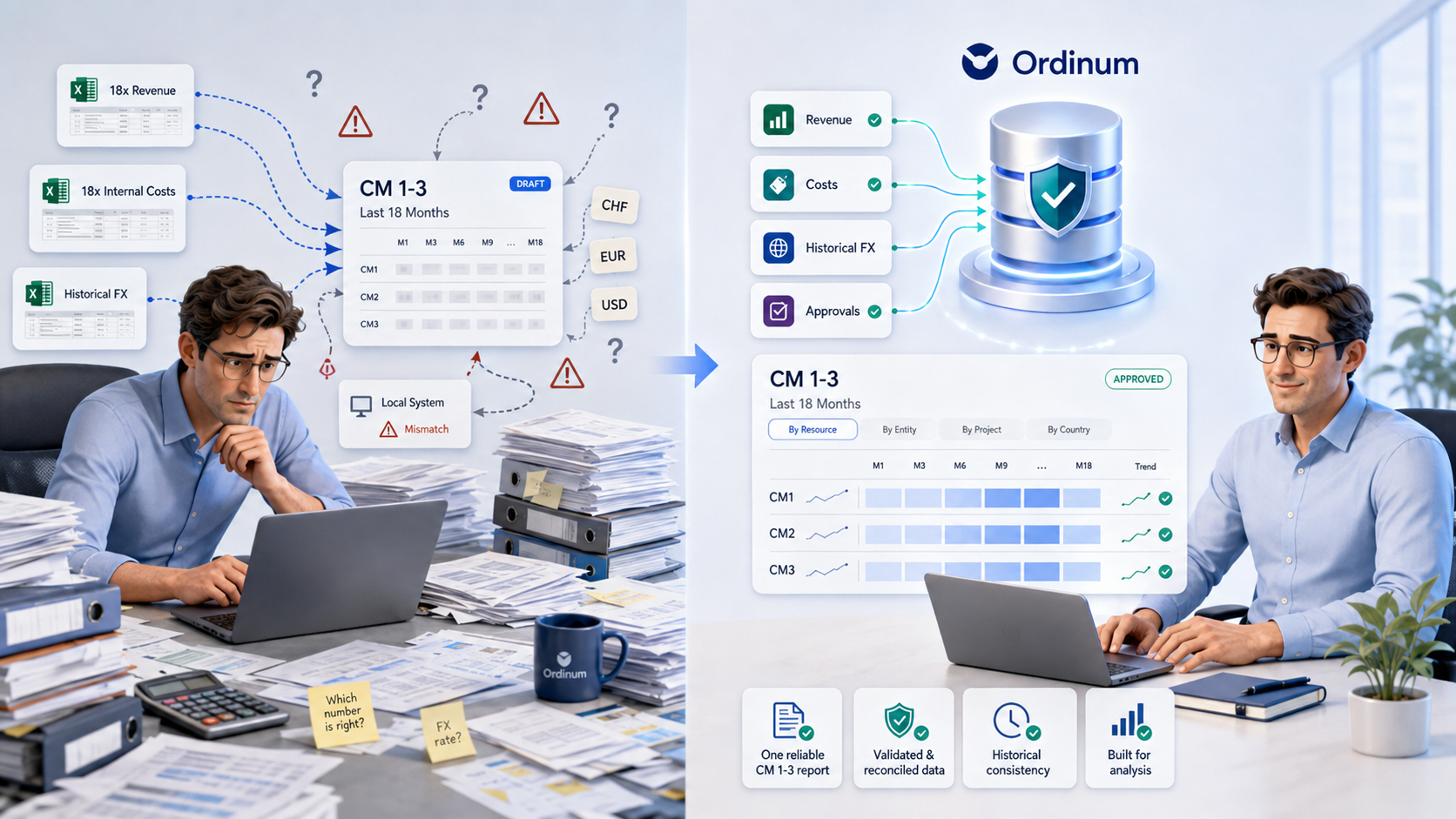
Ordinum centralises relational data, preserves historical validity and provides a single source of truth for flexible, reliable reporting.
Do you recognise this situation?
You need a consolidated CM 1–3 contribution-margin report covering the last 18 months, with the ability to analyse profitability by resource, project, entity or country. But the underlying revenue and cost data cannot be retrieved from one reliable source.
Instead, the information may be spread across monthly utilisation or project reports, internal cost reports, ERP extracts and separate exchange-rate data. In practice, this can mean consolidating 18 monthly revenue reports with another 18 internal cost reports before the analysis can even begin.
The consolidation quickly becomes a major exercise. Files must be combined, historical exchange rates applied correctly and discrepancies with local source systems investigated. Unusual movements in cost rates, billing rates or currencies create further uncertainty about which numbers can actually be trusted. The challenge increases when management wants to analyse the same figures by resource, project, client, entity, country or business unit, while assignments, rates and organisational structures may themselves have changed over time.
Faulty reporting can distort profitability analysis and undermine strategic decisions, while underlying inconsistencies may also point to errors affecting billing, payroll or project profitability.
Ordinum helps by connecting revenue, costs, resources, projects, assignments and organisational data in one structured relational model. Built-in approvals, validation rules and historical validity help ensure that exchange rates, cost rates, billing rates and organisational relationships are applied to the correct periods. The result is reliable contribution-margin reporting that can be analysed flexibly across relevant dimensions, without rebuilding the consolidation in Excel each time.
Built from working experience, not from a blank page
Ordinum already has a working reference system covering project and resource setup, validated time registration, approvals, payroll and billing calculations, data-quality controls and reporting. The screenshots below are from that system and show how these concepts work in practice.
More of the reference system
Additional screens show how HR history, schedules and costs connect to the wider process.
Controls that support the wider process
Recognise one of these situations?
Let us look at where better structure, validation and automation could create value in your organisation.